

You May Own More AI Than You Realize
Why index funds and 401(k)s may carry more concentration risk than most investors expect.
WEEKLY BLOG 6/1/26 – 6/5/26
Most people do not think of themselves as AI investors.
They think they own a 401(k). Or an index fund. Or a target-date fund. Or “the market.”
That all sounds simple. Broad. Diversified. Low maintenance.
And in many ways, it is.
But there is a difference between owning a diversified fund and understanding what is actually driving it.
Right now, a lot of investors may have more exposure to artificial intelligence than they realize. Not because they went out and bought every AI stock they could find. Because the market did it for them.
The index fund is not as neutral as it feels
The S&P 500 is often treated like a plain vanilla investment.
You buy the index, you own 500 large U.S. companies, and you let time do the work. That is not wrong. But it is incomplete.
The S&P 500 is market-cap weighted. That means the biggest companies get the biggest weights. If a handful of companies grow dramatically, they naturally become a larger share of the index.
That is exactly what has happened.
AI, cloud computing, semiconductors, mega-cap tech, and the companies building the infrastructure around them have become a much bigger part of the market.
The result is that investors can be “passive” and still be very exposed to one theme.
Top Holdings in the Vanguard S&P 500 ETF (VOO)
|
Rank |
Company |
Theme |
Approx. Weight in VOO |
|
1 |
Nvidia |
AI / Semiconductors |
~6.5% |
|
2 |
Apple |
Mega-Cap Tech |
~6.3% |
|
3 |
Microsoft |
AI / Cloud |
~6.2% |
|
4 |
Amazon |
Cloud / AI Infrastructure |
~3.8% |
|
5 |
Alphabet (A + C) |
AI / Cloud |
~3.7% |
|
6 |
Meta |
AI / Social |
~2.6% |
|
7 |
Broadcom |
AI / Semiconductors |
~2.0% |
|
|
Top 7 Combined |
|
~31.1% |
|
|
Top 10 Combined |
|
~38.4% |
Source: Stock Analysis, Vanguard S&P 500 ETF (VOO) holdings as of June 12, 2026. Approximate weights rounded for illustration. Top 10 total: 38.37%.
Your 401(k) may be part of the same story
This matters because most people are not checking the underlying holdings of their retirement account.
They pick a large-cap growth fund, an S&P 500 fund, a target-date fund, or whatever option looked reasonable when they enrolled. Then life gets busy. Years go by. The paycheck contributions continue. And the portfolio quietly changes underneath the surface.
A fund that felt broadly diversified five or ten years ago may now be more concentrated in the same group of companies that dominate the headlines.
That does not automatically make it bad. It just means you should know what you own.
There is a big difference between intentional risk and accidental risk.
Concentration is not always a problem
This is where people can overreact.
The fact that a handful of companies make up a large part of the market does not mean those companies are bad investments. Many of them are profitable, powerful, innovative businesses. Some have earned their position by growing revenue, expanding margins, and building products the world uses every day.
The market is not concentrated by accident. It is concentrated because those companies have won. At least so far.
But winning companies can still become crowded investments. Great businesses can still disappoint if expectations get too high. And strong themes can still create risk when everyone owns the same thing through different vehicles.
You may own AI through your S&P 500 fund. You may own it again through a growth fund. You may own it again through a target-date fund. You may own it again through an individual stock account. You may own it again through a technology ETF.
Individually, each decision can make sense. Together, the exposure can become larger than intended.
Diversification is not just the number of holdings
This is one of the biggest misconceptions in investing.
Owning 500 stocks sounds diversified. But if the top 10 stocks drive a large portion of the portfolio, the real experience may be less diversified than the number suggests.
Diversification is not just how many names you own. It is how much of your outcome depends on the same few drivers.
Right now, many portfolios depend heavily on a few big themes: AI spending, semiconductor demand, cloud growth, mega-cap earnings, and investor willingness to keep paying high valuations for future growth.
Those themes may continue. But a plan should not require them to continue perfectly.
What should investors do?
The answer is not to panic. It is not to sell everything with an AI label. And it is definitely not to assume that because something went up, it must come down tomorrow.
The answer is to look.
Look at your 401(k) allocation. Look at your fund overlap. Look at how much is in U.S. large-cap growth. Look at whether your target-date fund is doing what you think it is doing. Look at whether your outside accounts are doubling up on the same companies you already own through retirement plans.
That is planning. Not prediction.
This is also why investment decisions should not happen in isolation. Your retirement accounts, taxable accounts, cash, debt, income needs, tax situation, and timeline all connect.
A 35-year-old adding to a 401(k) every paycheck can absorb concentration differently than a 62-year-old preparing to draw income from the portfolio. Same market. Different planning problem.
Final thought
AI may turn out to be one of the most important investment themes of our lifetime. It may also go through painful cycles along the way.
Both things can be true.
The goal is not to avoid innovation. The goal is to make sure your financial future is not accidentally dependent on one story going perfectly.
“I own the market” is not a plan. It is a starting point.
Sources
S&P Dow Jones Indices, S&P 500 overview. S&P 500 includes 500 leading U.S. companies covering approximately 80% of available U.S. market capitalization. https://www.spglobal.com/spdji/en/indices/equity/sp-500/
Stock Analysis, Vanguard S&P 500 ETF (VOO) holdings. Top 10 holdings accounted for 38.37% of the fund as of June 12, 2026. https://stockanalysis.com/etf/voo/holdings/
The Motley Fool, “The Magnificent Seven Stocks: Market Cap, S&P 500 Weight, and Returns.” Magnificent Seven represented 33.8% of the S&P 500 in early June 2026. https://www.fool.com
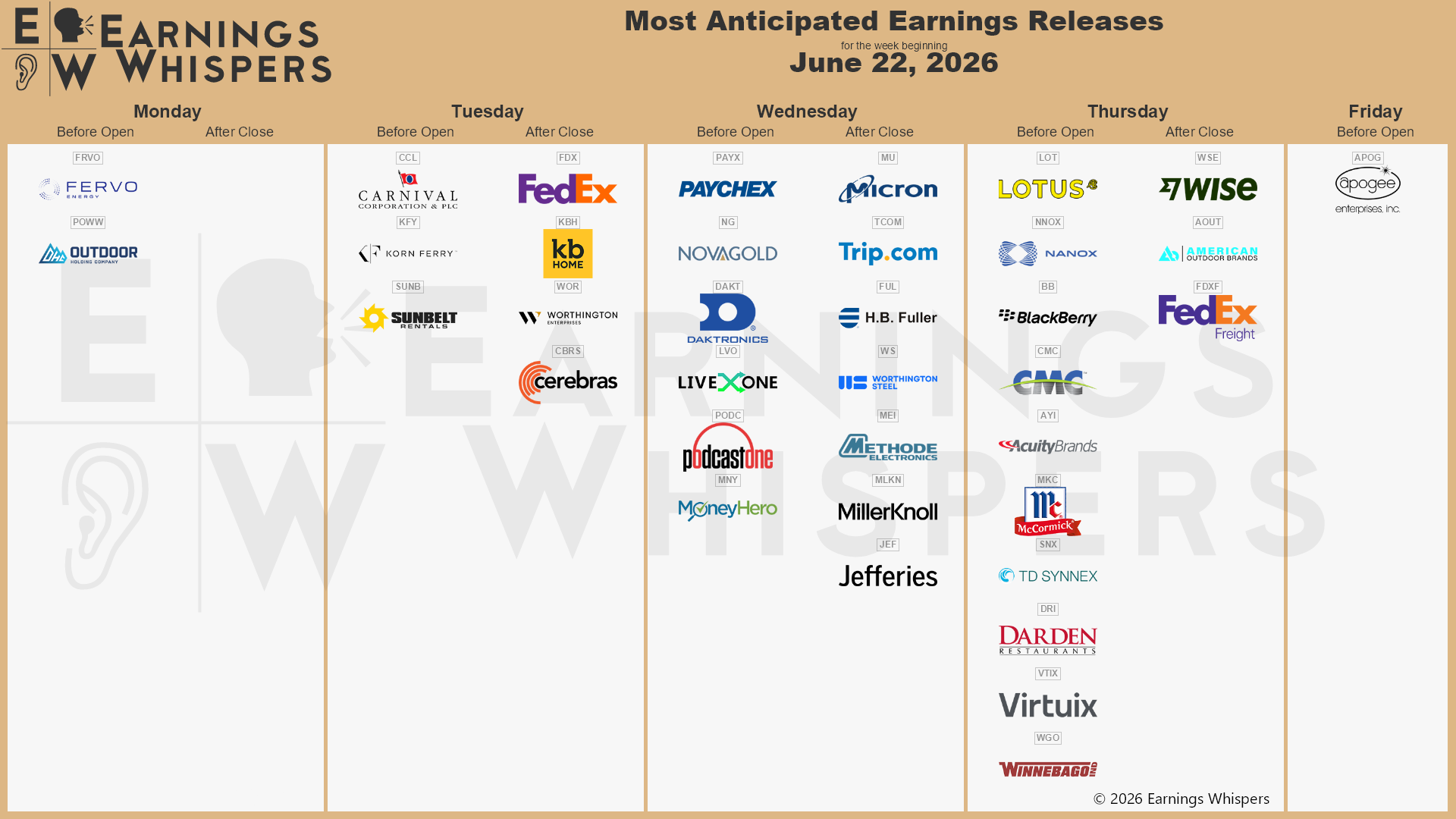
| Time (ET) | Report |
| Monday, Jun. 22 | |
| No events scheduled | |
| Tuesday, Jun. 23 | |
| 9:45 AM | US Flash Manufacturing PMI |
| 9:45 AM | US Flash Services PMI |
| Wednesday, Jun. 24 | |
| 10:00 AM | New Home Sales |
| 4:00 PM |
Federal Reserve Board releases annual
bank stress test results
|
| Thursday, Jun. 25 | |
| 8:30 AM | Durable Goods |
| 8:30 AM | 3rd estimate GDP |
| 8:30 AM | Weekly Jobless Claims |
| 8:30 AM | Personal Income, M/M% |
| 8:30 AM | Consumer Spending, M/M% |
| 8:30 AM | PCE Price Idx, M/M% |
| 8:30 AM | PCE Price Idx, Y/Y% |
| 8:30 AM | PCE Core Price Idx, M/M% |
| 8:30 AM | PCE Core Price Idx, Y/Y% |
| 11:00 AM | Kansas City Fed Survey |
| 6:30 PM |
FRB Chicago President Austan Goolsbee
speaks at Chicago Council on Global Affairs
|
| Friday, Jun. 26 | |
| 8:30 AM | Advance Economic Indicators Report |
| 8:30 AM | Wholesale Inventories |
| 8:30 AM | Retail Inventories |
| 10:00 AM | U. Michigan Final Consumer Survey |
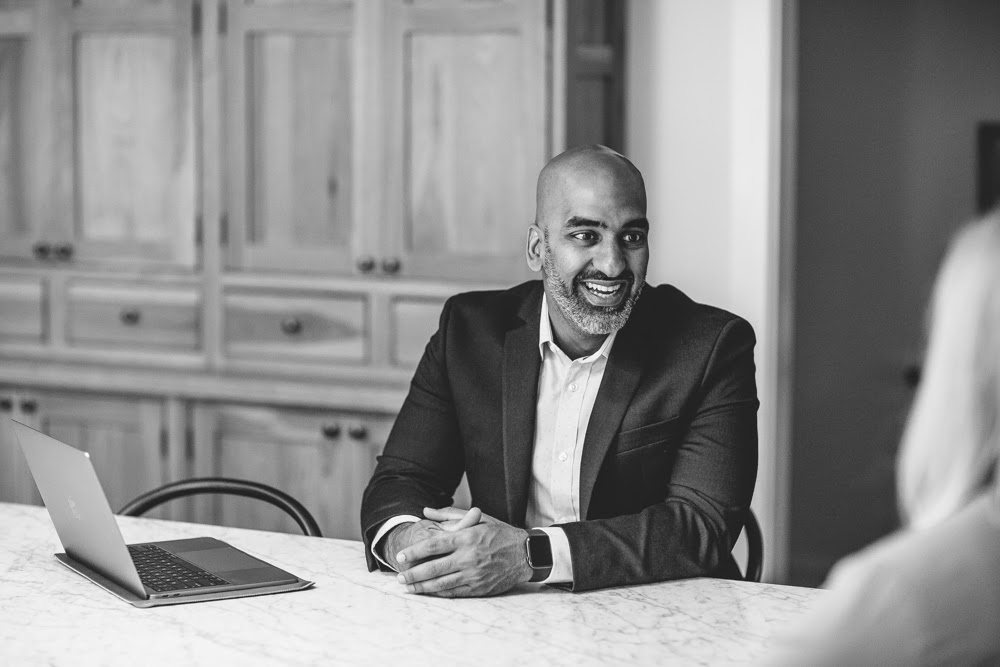
About Amit: I am a first generation American, the son of a working-class Indian family, and I lived through my parents’ struggle to find their place in this country, to put down roots that would sustain them as well as their children in a new land. As they encouraged me to excel in school and fostered my hobbies and interests, I was keenly aware of the dynamic between them. I understood that there was a difference between where they came from individually and where we were now. They worked hard in their individual capacities, but they weren’t always on the same page about financial issues – and that can make or break a family’s future. I didn’t know it at the time, but this laid the groundwork for my passion towards financial services and helping families succeed.
IMPORTANT NOTICE AND DISCLOSURE
The information and material contained in this communication is confidential and intended for the recipient addressee named. If you are not the intended recipient please delete the message and notify the sender immediately.
NewEdge Advisors, LLC is an Investment Adviser registered with the Securities and Exchange Commission. Any information provided has been obtained from sources considered reliable, but we do not guarantee the accuracy or the completeness of any description of securities, markets or developmentsmentioned. As a precautionary measure, we cannot rely on e-mail requests to authorize, direct or effect the purchase or sale of any security, wire transfer, or to affect any other transactions. Such requests, orders, or other instructions sent by email should be confirmed verbally, prior to their anticipated execution. We are unable to ensure email sent to you from us, or sent from you to us will be received. Please contact us at 845-652-3449 if there is any change in your financial situation, needs, goals or objectives, or if you wish to initiate any restrictions on the management of the account or modify existing restrictions. Additionally, we recommend you compare any account reports from NewEdge Advisors LLC with the account statements from your Custodian. Please notify us if you do not receive statements from your Custodian on at least a quarterly basis. Our current disclosure brochure, Form ADV Part 2, is available for your review upon request. This disclosure brochure, or a summary of material changes made, is also provided to our clients on an annual basis. This material was prepared with the assistance of AI. All content has been reviewed, edited, and approved by Forefront Wealth Planning prior to use. This is general education and not a substitute for personalized tax, legal, or investment advice. Your situation should be reviewed with the appropriate professionals before taking action. Advisory services offered through NewEdge Advisors, LLC, a registered investment adviser.