

Your Cash Is Earning More. So Is the IRS.
Why the headline yield does not tell the full story
WEEKLY BLOG 08/03/26 – 08/07/26

Cash is finally paying people again.
After years of earning almost nothing in savings accounts, money market funds, and CDs, seeing a meaningful yield feels like a win.
And in many ways, it is.
Cash can provide stability. It can create flexibility. It can help cover an emergency, fund a purchase, or keep you from selling investments at the wrong time.
But there is another side to the story.
The interest showing up in your account may not be the amount you actually keep.
A 4% Yield Is Not Always a 4% Return
At its July meeting, the Federal Reserve kept the federal funds rate in a range of 3.50% to 3.75%. That is one reason cash yields remain more attractive than they were during the near-zero rate environment of a few years ago.
The number most people focus on is the advertised yield.
The more important number is the after-tax yield.
Consider a simple example.
If $250,000 earns 4%, that produces $10,000 of annual interest. If federal and state taxes absorb 35% of that income, the investor keeps $6,500.
That turns a 4% headline yield into a 2.6% after-tax yield.
|
|
Gross Yield |
After 35% Tax Drag |
|
$250,000 balance |
4.0% yield |
2.6% yield |
|
Annual interest earned |
$10,000 |
$6,500 |
|
What it means |
The advertised rate |
What is actually kept |
Source: Hypothetical example for illustrative purposes only. Actual tax impact varies by federal and state bracket.
The account still earned money. The cash may still be doing exactly what it is supposed to do.
But the result looks different once taxes are included.
Interest from bank accounts, money market accounts, CDs, and many bonds is generally taxable. The IRS requires that taxable interest be reported even in certain cases where a Form 1099-INT is not received.
That does not make these accounts bad.
It just means the yield should not be viewed in isolation.
Cash Needs a Job
The bigger issue is not whether cash is good or bad.
It is whether the cash has a purpose.
An emergency fund needs to be liquid. Money for a home purchase next year probably should not be taking stock market risk. A business owner may need extra reserves to handle payroll, taxes, or an unexpected slowdown.
That cash is doing a job.
The problem starts when money intended for one purpose quietly becomes money with no purpose at all.
A large balance builds up because rates feel attractive. Months turn into years. The money keeps earning interest, but it may also keep generating taxes while losing purchasing power to inflation.
Meanwhile, long-term goals may be underfunded.
The cash feels safe.
But safe from what?
Market volatility is one type of risk. Inflation is another. Taxes are another. So is the risk of becoming too comfortable with an allocation that no longer fits the plan.
Not All Yields Are Equal
Two investments can advertise similar yields and produce very different outcomes.
The differences may include:
- Federal and state tax treatment
- Access to the money
- Credit and market risk
- FDIC insurance eligibility
- How long the yield is expected to last
- What happens if interest rates fall
Some municipal bonds may generate interest that is exempt from federal income tax, although the treatment can depend on the specific investment and the investor’s circumstances.
That does not automatically make a tax-exempt investment better.
A lower tax-exempt yield may be more attractive for one investor and less attractive for another. Liquidity, risk, time horizon, and the rest of the portfolio still matter.
The highest quoted yield is not always the best result.
The best result is the one that fits the job the money needs to do.
Ask Better Questions About Your Cash
Instead of asking only, “What is this account paying?” consider asking:
- What is the yield after taxes?
- When will I need this money?
- How much needs to be available immediately?
- What risks am I trying to avoid?
- Am I accepting different risks without realizing it?
- When will I revisit this decision?
These are planning questions, not predictions.
Nobody knows exactly where interest rates will go next. The goal is not to move every dollar whenever the Federal Reserve meets.
The goal is to make sure each dollar has a purpose.
Final Thought
Cash is useful.
It helps people sleep at night. It creates options. It can prevent emotional decisions during difficult markets.
But cash is not automatically efficient just because it earns interest.
The headline yield is only the beginning of the calculation. What matters is what you keep, what the money is for, and whether it still fits the rest of the plan.
If a cash balance has grown meaningfully over the last few years, this may be a good time to revisit it.
Not because the cash needs to be moved.
Because it needs to have a job.
Sources
Federal Reserve, FOMC Statement, July 29, 2026. https://www.federalreserve.gov/newsevents/pressreleases/monetary20260729a.htm
Internal Revenue Service, Topic No. 403, Interest Received. https://www.irs.gov/taxtopics/tc403
Internal Revenue Service, Tax-Exempt Bonds. https://www.irs.gov/tax-exempt-bonds
Internal Revenue Service, Form 1099-INT Interest Income. https://www.irs.gov/forms-pubs/about-form-1099-int
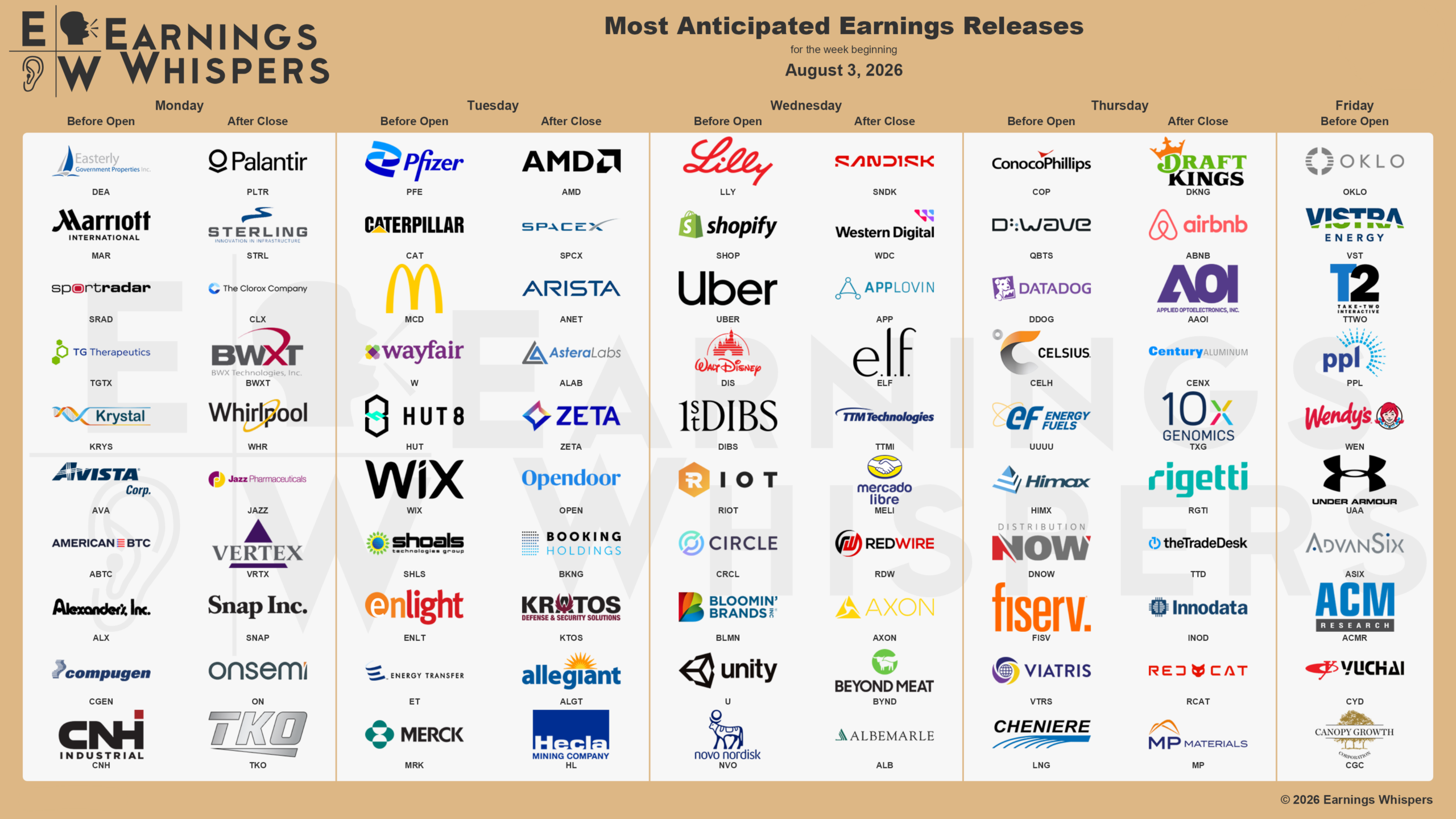
Stock Market Calendar This Week:
|
Time(ET)
|
Report |
| Monday, Aug. 3 | |
| 9:45 AM | US Manufacturing PMI |
| 10:00 AM | ISM Report On Business Manufacturing PMI |
| 10:00 AM | Construction Spending |
| Tuesday, Aug. 4 | |
| 8:30 AM | Trade |
| 10:00 AM | Job Openings & Labor Turnover Survey |
| 10:00 AM | Factory Orders |
| TBA | Federal Reserve Bank of Kansas City President Jeffrey Schmid speech |
| Wednesday, Aug. 5 | |
| 8:15 AM | ADP National Employment Report |
| 9:45 AM | US Services PMI |
| 10:00 AM | ISM Report On Business Services PMI |
| 4:05 PM | Federal Reserve Governor Lisa Cook speaks at Anchorage Economic Development Corporation Economic Luncheon |
| Thursday, Aug. 6 | |
| 8:30 AM | Preliminary Productivity and Costs |
| 8:30 AM | Weekly Jobless Claims |
| 10:00 AM | Monthly Wholesale Trade |
| Friday, Aug. 7 | |
| 8:30 AM | Employment Report |
| 8:30 AM | Unemployment Rate |
| 8:30 AM | Avg Hourly Earnings, M/M% |
| 8:30 AM | Avg Hourly Earnings, Y/Y% |
| 10:00 AM | NABE fireside chat with Federal Reserve Bank of Richmond President Thomas Barkin |
| 3:00 PM | Consumer Credit |

About Amit: I am a first generation American, the son of a working-class Indian family, and I lived through my parents’ struggle to find their place in this country, to put down roots that would sustain them as well as their children in a new land. As they encouraged me to excel in school and fostered my hobbies and interests, I was keenly aware of the dynamic between them. I understood that there was a difference between where they came from individually and where we were now. They worked hard in their individual capacities, but they weren’t always on the same page about financial issues – and that can make or break a family’s future. I didn’t know it at the time, but this laid the groundwork for my passion towards financial services and helping families succeed.
IMPORTANT NOTICE AND DISCLOSURE
The information and material contained in this communication is confidential and intended for the recipient addressee named. If you are not the intended recipient please delete the message and notify the sender immediately.
NewEdge Advisors, LLC is an Investment Adviser registered with the Securities and Exchange Commission. Any information provided has been obtained from sources considered reliable, but we do not guarantee the accuracy or the completeness of any description of securities, markets or developmentsmentioned. As a precautionary measure, we cannot rely on e-mail requests to authorize, direct or effect the purchase or sale of any security, wire transfer, or to affect any other transactions. Such requests, orders, or other instructions sent by email should be confirmed verbally, prior to their anticipated execution. We are unable to ensure email sent to you from us, or sent from you to us will be received. Please contact us at 845-652-3449 if there is any change in your financial situation, needs, goals or objectives, or if you wish to initiate any restrictions on the management of the account or modify existing restrictions. Additionally, we recommend you compare any account reports from NewEdge Advisors LLC with the account statements from your Custodian. Please notify us if you do not receive statements from your Custodian on at least a quarterly basis. Our current disclosure brochure, Form ADV Part 2, is available for your review upon request. This disclosure brochure, or a summary of material changes made, is also provided to our clients on an annual basis. This material was prepared with the assistance of AI. All content has been reviewed, edited, and approved by Forefront Wealth Planning prior to use. This is general education and not a substitute for personalized tax, legal, or investment advice. Your situation should be reviewed with the appropriate professionals before taking action. Advisory services offered through NewEdge Advisors, LLC, a registered investment adviser.