

What Last Week Was Actually Testing
Why a hard week in the market is exactly what a financial plan is built for
WEEKLY BLOG 11/15/26 – 11/21/26
If last week left you rattled, you’re in good company. It was a hard week to own stocks, and it’s okay to feel that.
Before we get into what happened, here’s the part I most want you to hear. A week like this is exactly what a financial plan is built for. A good plan doesn’t treat it as a surprise. It expected weeks like this from the very beginning.
What actually happened last week
The S&P 500 fell 8.6% for the week and closed Friday at 6,910. That was its worst week since April 2025. It fell seven days in a row for the first time since February 2020, and it finished 11.6% below its October 6 high. The Nasdaq lost 10%. Chip stocks had their worst week since September 2001.
A lot hit at once. Nvidia’s longtime CEO resigned. A string of outages at Microsoft, the FAA, Chase and Apple shook confidence in systems most of us take for granted. Most of those were later traced to software and hardware updates. The Fed is still raising rates because inflation hasn’t cooled the way anyone hoped. And Anthropic’s IPO, the largest in history, jumped on day one and then gave back most of that gain.
The VIX, often called the market’s fear gauge, briefly touched 40 on Friday. It doesn’t get there often.
Here’s what didn’t fall apart. Retail sales hit a record. Jobless claims are low at 203,000. The Atlanta Fed’s running estimate puts fourth quarter growth at 3.2%. The hard numbers on the economy look a lot better than the mood does right now.
This is more normal than it feels
Since 2009 the S&P 500 has had 34 drops of 5% or more, according to Charlie Bilello. Most people couldn’t name more than two or three of them. In an average year, the index falls about 14% from its high at some point, even in years that finish up. Last week’s decline still sits inside that range.
I can barely remember why stocks fell 14% in early 2016. It felt enormous at the time. My suggestion is to write down what you’re feeling right now. The point isn’t to dwell on it. It’s to have a record of how big these moments feel while you’re inside them, so the next one has some context. I re-read what I wrote down in 2022 when the market was down nearly 20% and it helped me realize that in the middle of it, you always think it won’t ever get better.
The best days live next door to the worst ones
J.P. Morgan ran the numbers on $10,000 put into the S&P 500 at the start of 2005. Left alone through the end of 2024, it grew to about $71,750. Miss just the 10 best days in those 20 years and it ends at about $32,871. Less than half.
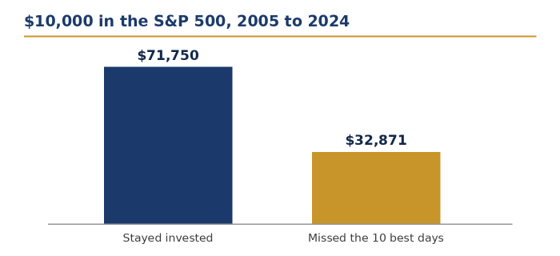
Source: J.P. Morgan Asset Management. Hypothetical $10,000 invested in the S&P 500 from January 1, 2005 through December 31, 2024. For illustration only.
The part that matters this week is when those best days happened. Seven of the 10 best came within two weeks of the 10 worst. In March 2020, the market’s second worst day of the year was March 12. Its second best day was March 13.
To be fair, someone who somehow skipped both the 10 best and the 10 worst days would have ended up about even. But nobody gets to pick only the bad ones. They show up in clumps, right next to each other, with no warning in between.
Behavior beats intelligence
The people who sell in a week like this usually aren’t foolish. Most are smart and well informed. They read the same headlines we all read, and they’re reacting to real things. That’s what makes it so hard.
Morningstar tracks the gap between what funds earn and what the people in them actually earn. Over the ten years ending in 2025, the average fund returned 9.9% a year. The average investor dollar in those same funds earned 8.7%. That gap comes from the timing of when people bought and sold. It was widest in the most volatile funds, about 2.1% a year, and smallest in the calmest ones, about 0.4%.
|
Morningstar, 10 years ending 2025 |
Result |
|
Average fund return |
9.9% a year |
|
Average investor dollar in those same funds |
8.7% a year |
|
Gap across all funds |
1.2% a year |
|
Gap in the most volatile funds |
About 2.1% a year |
|
Gap in the calmest funds |
About 0.4% a year |
Source: Morningstar, Mind the Gap 2025.
Same funds. Same markets. Different behavior.
There’s a concept professionals call positioning. It’s how much investors already own of something, or how heavily they’re betting against it. Last week, trend-following funds sat near their most bearish levels in years, and fund managers made their biggest cut to tech since 2006. When nearly everyone has already run for the exits, there are fewer people left to sell. That’s part of why the moments that feel scariest have often been the worst times to get out.
I feel the pull too. I’m human, and when I look at my own accounts on a day like Friday, I get the same urge to do something. What changes with experience isn’t the feeling. It’s having a plan already in place to answer it.
Intelligence picks the plan. Behavior decides whether it works.
The plan is the product, not the portfolio
A portfolio is a set of investments. A plan is what decides how much risk you can actually afford, where your next few years of spending come from, and what you’ll do before the scary week ever arrives. The portfolio gets the attention. The plan does the work.
It’s why emergency funds matter so much. That cash isn’t there to earn anything. It’s there so a job change, a new roof, or a medical bill never forces you to sell stocks after they’ve fallen.
The emergency fund protects the portfolio from your life.
It’s why risk comes down as retirement gets closer. Someone who stops working at 55 has years before most retirement accounts open up without penalties. Those bridge years need to be funded from somewhere stable. If the next couple of years of spending already sit in cash and fixed income, a week like last week is uncomfortable to watch. It isn’t a crisis. Those bonds are doing the boring job they were hired to do.
And if you’re still working and saving, the math runs the other way. Every contribution right now buys more shares than it did a month ago. You won’t feel that this week. It shows up years from now.
A planner’s job in weeks like this is mostly to keep a good plan from getting abandoned. For our clients right now, that means harvesting tax losses in taxable accounts so a down market leaves something useful behind at tax time. It means confirming cash reserves for anyone taking income. And for those starting income in the next few years, it means planning the next shift toward fixed income so it never has to happen at a bad moment.
Markets recover. The calendar is the part nobody knows.
The US stock market has come back from every decline in its history. The 2008 financial crisis. The 2020 pandemic. The tariff shock of April 2025, which the S&P 500 had fully recovered from by late June that same year.
Some recoveries took weeks. Some took years. A few took much longer than that. History is clear that recoveries come. It says nothing about when.
That gap between “it will recover” and “I don’t know when” is the whole reason a plan exists. Past results don’t guarantee anything going forward, so we don’t build plans that need the market to cooperate on schedule. We build them so you can wait as long as it takes without being forced to sell.
Where I could be wrong
This could get worse before it gets better. Only eight weeks since 1999 were worse than last week, and after six of them, stocks fell at least another 17% within a year. Some strategists see parallels to 2000, when tech fell first and the broader bear market came after the Fed kept tightening.
The bigger question underneath all of this is whether the huge amount being spent on AI will earn a return. That won’t be answered in a week or a quarter.
I’m not trying to call a bottom. A good plan doesn’t need to know where the bottom is. It needs enough cash and fixed income that you never have to sell stocks to live, however long the bottom takes to arrive.
The week a plan earns its keep
Most of the year, a financial plan is quiet. It sits in the background while markets go up and nobody thinks about it. Weeks like this are when it earns its keep.
If you already have a plan, this is the week to trust it. If you’ve never been sure whether yours is built for a stretch like this, that’s a conversation worth having before the next one. Our door is always open.
Sources
J.P. Morgan Asset Management, missing the best days research
Morningstar, Mind the Gap 2025
TheStreet, the S&P 500’s worst week since April 2025
24/7 Wall St via Yahoo Finance, the eight worse weeks since 1999
Did you miss our last blog?
Everyone Was on the Same Side of the Boat
Stock Market Calendar This Week:
| Time (ET) | Report |
| Monday, Nov. 23 | |
| 9:45 AM | US Flash Manufacturing PMI |
| 9:45 AM | US Flash Services PMI |
| 4:00 PM | FRB New York President John Williams speaks at University of Mount Saint Vincent |
| Tuesday, Nov. 24 | |
| 9:00 AM | S&P Cotality Case-Shiller Home Px Index |
| 10:00 AM | Conference Bd – Consumer Confidence |
| Wednesday, Nov. 25 | |
| 8:30 AM | 2nd estimate GDP |
| 8:30 AM | Weekly Jobless Claims |
| 8:30 AM | Durable Goods |
| 8:30 AM | Personal Income, M/M% |
| 8:30 AM | Consumer Spending, M/M% |
| 8:30 AM | PCE Price Idx, M/M% |
| 8:30 AM | PCE Price Idx, Y/Y% |
| 8:30 AM | PCE Core Price Idx, M/M% |
| 8:30 AM | PCE Core Price Idx, Y/Y% |
| 10:00 AM | New Home Sales |
| 2:00 PM | Federal Reserve Beige Book |
| Thursday, Nov. 26 | |
| No events scheduled | |
| Friday, Nov. 27 | |
| 8:30 AM | Advance U.S. Trade Balance in Goods |
| 8:30 AM | Wholesale Inventories |
| 8:30 AM | Retail Inventories |

About Amit: I am a first generation American, the son of a working-class Indian family, and I lived through my parents’ struggle to find their place in this country, to put down roots that would sustain them as well as their children in a new land. As they encouraged me to excel in school and fostered my hobbies and interests, I was keenly aware of the dynamic between them. I understood that there was a difference between where they came from individually and where we were now. They worked hard in their individual capacities, but they weren’t always on the same page about financial issues – and that can make or break a family’s future. I didn’t know it at the time, but this laid the groundwork for my passion towards financial services and helping families succeed.
IMPORTANT NOTICE AND DISCLOSURE
The information and material contained in this communication is confidential and intended for the recipient addressee named. If you are not the intended recipient please delete the message and notify the sender immediately.
NewEdge Advisors, LLC is an Investment Adviser registered with the Securities and Exchange Commission. Any information provided has been obtained from sources considered reliable, but we do not guarantee the accuracy or the completeness of any description of securities, markets or developmentsmentioned. As a precautionary measure, we cannot rely on e-mail requests to authorize, direct or effect the purchase or sale of any security, wire transfer, or to affect any other transactions. Such requests, orders, or other instructions sent by email should be confirmed verbally, prior to their anticipated execution. We are unable to ensure email sent to you from us, or sent from you to us will be received. Please contact us at 845-652-3449 if there is any change in your financial situation, needs, goals or objectives, or if you wish to initiate any restrictions on the management of the account or modify existing restrictions. Additionally, we recommend you compare any account reports from NewEdge Advisors LLC with the account statements from your Custodian. Please notify us if you do not receive statements from your Custodian on at least a quarterly basis. Our current disclosure brochure, Form ADV Part 2, is available for your review upon request. This disclosure brochure, or a summary of material changes made, is also provided to our clients on an annual basis. This material was prepared with the assistance of AI. All content has been reviewed, edited, and approved by Forefront Wealth Planning prior to use. This is general education and not a substitute for personalized tax, legal, or investment advice. Your situation should be reviewed with the appropriate professionals before taking action. Advisory services offered through NewEdge Advisors, LLC, a registered investment adviser.