

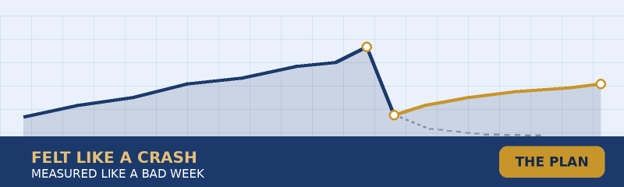
The Week That Felt Worse Than It Was
Why last week looked like a crash and measured like a bad week.
WEEKLY BLOG 11/8/26 – 11/14/26
Last Thursday was ugly.
The S&P 500 fell 4.36% on November 5, its worst day since the tariff crash in April 2025. The Nasdaq dropped about 5.5%. The Dow lost more than 1,800 points. Chip stocks had their worst day since March 2020. If you checked your account that night, you probably closed the app faster than you opened it.
Here is the part that didn’t make the headlines. The day before was the market’s best day in three months. On Friday the Nasdaq bounced 1.1%. When the dust settled, the S&P 500 finished the week down 2.68%.
That is a real loss. It was also the worst week since April 2025, which tells you how calm the last eighteen months have been. The index sits about 5.6% below its October 6 record, and every major index is still up for 2026.
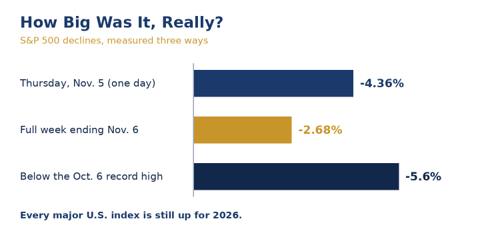
Source: Associated Press and 24/7 Wall St. figures as cited in this post.
The week felt like a crash. The numbers say it was a bad week. Those are two different things, and the gap between them is where most investing mistakes get made.
What actually happened
Democrats won control of both the House and the Senate on Tuesday, November 3. Wall Street’s reaction had less to do with party and more to do with one specific question. Investors started asking whether the AI data center buildout slows under a new Congress. More scrutiny. More permitting fights. Maybe higher costs.
That question hit hardest where prices had run the furthest. Chipmakers and data center suppliers led the selling. A big share of the market’s gains over the past year came from that same corner, so when it cracked, the whole index felt it.
This matters for perspective. Last week wasn’t the market deciding the economy is broken. It was the market repricing one very crowded, very expensive bet.
The economy didn’t get the memo
On Friday the October jobs report came out. Economists expected about 65,000 new jobs. The economy added 165,000. Unemployment dipped to 4.1%. Hiring in August and September was revised up by a combined 84,000, and wages rose 0.4% for the month.
Companies are telling a similar story on their earnings calls. Visa says credit spending is up 11%. Caterpillar is taking orders out to 2030. Royal Caribbean says 2027 bookings are running ahead of normal. UPS describes a split economy where people with assets keep spending and people without them feel stretched, so the picture isn’t perfect. It just isn’t falling apart.
That’s not an economy rolling over. It’s a stock market that got ahead of itself in one area and paid for it in a few sessions.
The catch nobody likes to talk about
A strong economy has a downside right now. Inflation ran 3.7% in September, well above the Fed’s 2% target. A hot jobs report makes it harder for the Fed to ease. After Friday, futures markets priced roughly a 77% chance of a rate hike in December. The next inflation report lands Tuesday, November 10, and it will get a lot of attention.
There’s another wrinkle we’ve written about before. Normally when stocks fall, bonds rise and soften the blow. That’s the whole idea behind a stock and bond mix. When inflation is the main worry, the two can fall together. We saw it in 2022. Right now that relationship has drifted close to zero, which is part of why last week stung the way it did.
It’s also why we don’t ask bonds to be the only shock absorber. Cash reserves and short term Treasuries are doing that job well right now, and they’re paying a solid rate while they do it.
Why the plan matters more than the forecast
Here’s what a week like this looks like from inside a well built plan.
If you’re still working and saving, nothing changes. Your contributions kept going in. Thursday’s prices were simply cheaper than Wednesday’s.
If you’re retired or close to it, this is exactly why we keep a cash cushion for the next couple of years of spending. Nobody has to sell stocks after a 4% day to cover the mortgage or pay for a trip. The stocks get time to recover. The cash does the work in the meantime.
If you’re in the stretch between leaving work and turning 59½, living off cash and a taxable account, a down week can even be useful. It can be a chance to rebalance, or to realize losses that may offset gains you’ll take later.
Same week, three different situations
|
Where you are |
What last week meant |
What the plan does |
|
Still working and saving |
Thursday’s prices were cheaper than Wednesday’s |
Contributions keep going in |
|
Retired or close to it |
No need to sell stocks after a 4% day |
A cash cushion covers the next couple of years of spending |
|
Between leaving work and 59½ |
A down week can be useful |
A chance to rebalance or realize losses that may offset future gains |
Summary of the planning situations discussed in this post.
The plan is the product, not the portfolio. Weeks like last week are when that line stops being a slogan.
Where I could be wrong
Some sharp people think the selling has more room to run. Individual investors still hold near record amounts of stock and not much cash, and margin borrowing has climbed. If Tuesday’s inflation number runs hot or the Fed moves faster than expected, this could be a choppy winter. The AI spending story could keep unwinding for a while too. Companies are spending enormous sums, and the payoff will land unevenly.
History leans toward patience. One analyst noted the Nasdaq was higher a year after the election in 12 of the last 13 midterm cycles going back to 1974. That’s a pattern, not a promise, and this cycle has its own quirks.
I’m not going to tell you the bottom is in. Nobody knows that. What I can tell you is that a plan built for weeks like this one doesn’t need to know.
Final thought
Markets fall faster than they rise. That’s what makes days like Thursday feel so personal.
The money you need soon shouldn’t be in stocks. The money in stocks shouldn’t be needed soon. If that’s true for you, last week was noise.
If you’re not sure it’s true for you, that’s worth a conversation. It’s usually a short one.
Sources
- Market moves. Associated Press, market coverage of November 5 and 6, 2026
- Weekly performance. 24/7 Wall St., weekly S&P 500 performance, November 7, 2026.
- Jobs. U.S. Bureau of Labor Statistics, Employment Situation report for October 2026
- Inflation. U.S. Bureau of Labor Statistics, Consumer Price Index for September 2026
- Midterm history. CNBC, midterm election market history via Frank Cappelleri, November 2026.
- Rates and correlation. Market Macro Hub, fed funds futures pricing and stock and bond correlation data.
- Corporate commentary. Third quarter 2026 earnings calls from Visa, Caterpillar, Royal Caribbean and UPS.
Stock Market Calendar This Week:
|
Time (ET) |
Report |
|
Monday, Nov. 9 |
|
|
10:00 AM |
Wholesale Inventories (September) |
|
Earnings |
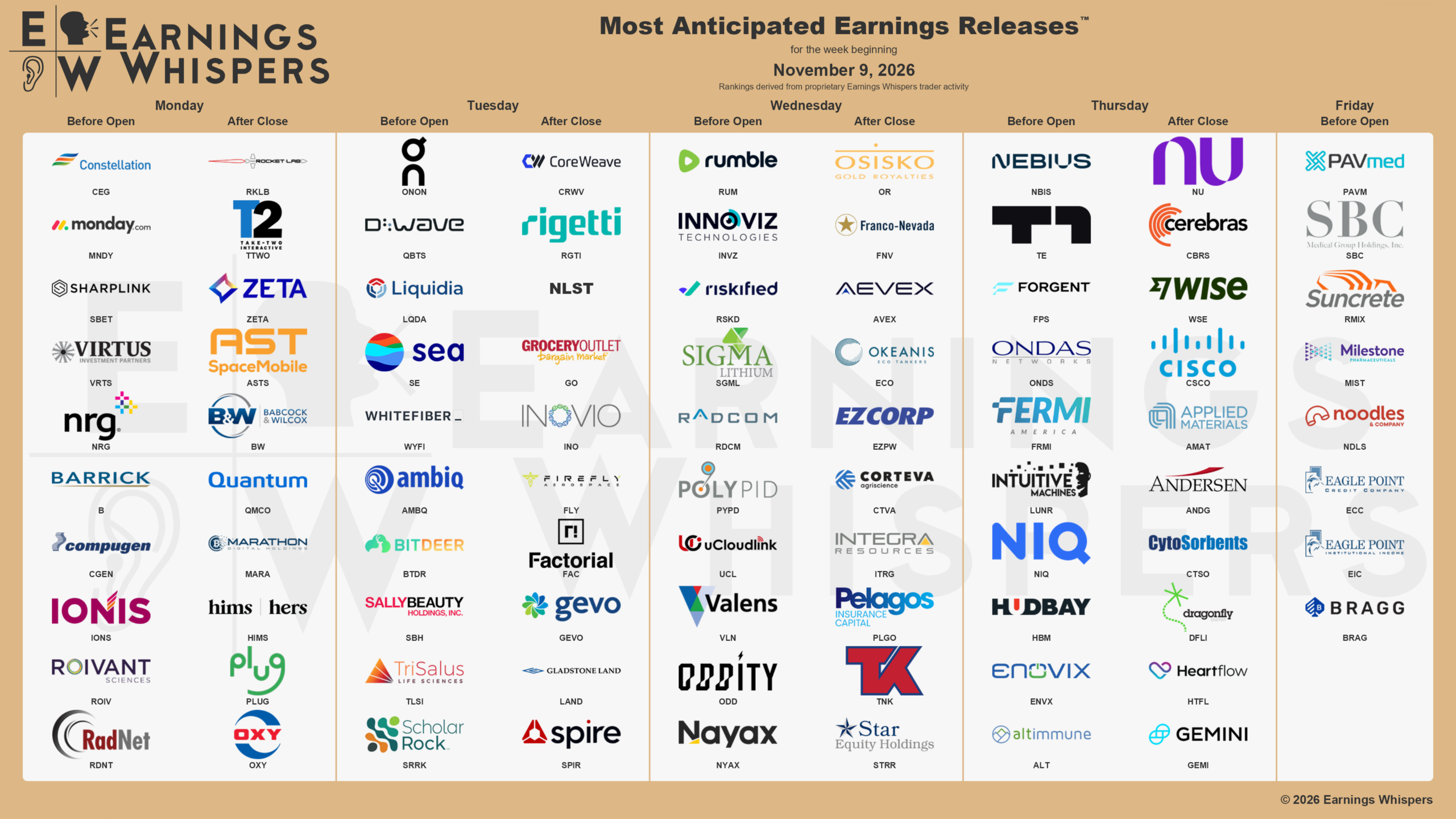
KKR and Barrick before the open; Take-Two Interactive, Occidental Petroleum, and Hims & Hers after the close |
|
Tuesday, Nov. 10 |
|
|
6:00 AM |
NFIB Small Business Optimism Index |
|
8:15 AM |
ADP Weekly Employment Reading |
|
8:30 AM |
Consumer Price Index (October) |
|
Earnings |
CoreWeave after the close; TransDigm also reports |
|
Wednesday, Nov. 11 |
|
|
All day |
Veterans Day: stock market open, bond market closed. No major releases scheduled |
|
Thursday, Nov. 12 |
|
|
6:30 AM |
New York Fed President John Williams speaks |
|
8:30 AM |
Weekly Jobless Claims |
|
10:00 AM |
Existing Home Sales |
|
Earnings |
Cisco and Applied Materials after the close |
|
Friday, Nov. 13 |
|
|
8:30 AM |
Producer Price Index (October) |
Source: Bureau of Labor Statistics release schedules, SIFMA holiday schedule, and company announcements via Regards of Wallstreet. Times are Eastern and subject to change.

About Amit: I am a first generation American, the son of a working-class Indian family, and I lived through my parents’ struggle to find their place in this country, to put down roots that would sustain them as well as their children in a new land. As they encouraged me to excel in school and fostered my hobbies and interests, I was keenly aware of the dynamic between them. I understood that there was a difference between where they came from individually and where we were now. They worked hard in their individual capacities, but they weren’t always on the same page about financial issues – and that can make or break a family’s future. I didn’t know it at the time, but this laid the groundwork for my passion towards financial services and helping families succeed.
IMPORTANT NOTICE AND DISCLOSURE
The information and material contained in this communication is confidential and intended for the recipient addressee named. If you are not the intended recipient please delete the message and notify the sender immediately.
NewEdge Advisors, LLC is an Investment Adviser registered with the Securities and Exchange Commission. Any information provided has been obtained from sources considered reliable, but we do not guarantee the accuracy or the completeness of any description of securities, markets or developmentsmentioned. As a precautionary measure, we cannot rely on e-mail requests to authorize, direct or effect the purchase or sale of any security, wire transfer, or to affect any other transactions. Such requests, orders, or other instructions sent by email should be confirmed verbally, prior to their anticipated execution. We are unable to ensure email sent to you from us, or sent from you to us will be received. Please contact us at 845-652-3449 if there is any change in your financial situation, needs, goals or objectives, or if you wish to initiate any restrictions on the management of the account or modify existing restrictions. Additionally, we recommend you compare any account reports from NewEdge Advisors LLC with the account statements from your Custodian. Please notify us if you do not receive statements from your Custodian on at least a quarterly basis. Our current disclosure brochure, Form ADV Part 2, is available for your review upon request. This disclosure brochure, or a summary of material changes made, is also provided to our clients on an annual basis. This material was prepared with the assistance of AI. All content has been reviewed, edited, and approved by Forefront Wealth Planning prior to use. This is general education and not a substitute for personalized tax, legal, or investment advice. Your situation should be reviewed with the appropriate professionals before taking action. Advisory services offered through NewEdge Advisors, LLC, a registered investment adviser.