

The Midterms Are Context, Not a Signal
What the four year presidential cycle can and can’t tell you about your money this week.
WEEKLY BLOG 11/1/26 – 11/7/26
History gives us context, not a signal to trade. That idea is worth holding onto this week, as the country heads to the polls on Tuesday.
Every election season brings a wave of charts and confident voices explaining what the outcome means for your money. This year the backdrop is louder than usual. The Fed held rates steady last week after raising them in September, and the vote wasn’t unanimous. Markets are already pricing in another hike in December.
Then came earnings season. Alphabet had the worst day in its history. Intel lost about 30% in a single session, its worst day since 1974. The Nasdaq gave back roughly $2 trillion in October as investors started asking harder questions about what all that AI spending will actually earn.
It’s natural to want to tie all of that to Tuesday’s vote. But the most useful thing history offers here isn’t a prediction. It’s perspective.
What history actually shows
The long run pattern is real. Midterm years have tended to be bumpy, and the year after has tended to be strong.
Researchers call it the four year presidential cycle. Capital Group looked at S&P 500 total returns from 1930 to 2022 and found midterm years averaged 4.7%. That’s about half the 9.5% average of all other years. Volatility runs higher too, especially in the late summer and fall before the vote. Since 1970, midterm years have carried a median volatility near 16%, compared with 13% in other years.
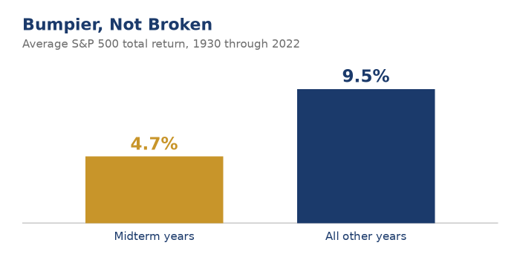
Source: Capital Group, S&P 500 total returns from 1930 through 2022. Past performance does not guarantee future results.
Then the mood usually shifts. Since 1950, the S&P 500 has averaged a 15.4% price return in the twelve months after a midterm Election Day. Capital Group’s data shows no negative one year stretch after any midterm in that period.
One explanation is simple. Markets dislike uncertainty more than they dislike bad news. The president’s party almost always loses ground in a midterm, so investors expect it. What they can’t price is how big the shift will be until the votes are counted. Once they are, everyone knows the playing field, even if they don’t love it.
The data on which party wins is just as telling. Going back to 1933, Capital Group found markets averaged double digit returns under one party control, under a split Congress, and when the opposing party ran Congress. The scoreboard has mattered far less than the people cheering for it would like to believe.
Two midterms worth remembering
The averages hide the real story. In the years that mattered most, the economy drove markets far more than the ballot did.
1974. That midterm landed in the middle of an oil shock, double digit inflation, and the Watergate scandal that ended with President Nixon’s resignation in August. Stocks struggled badly. But no one could say the election caused it, or that the election could fix it.
A vote can change who sits in Washington. It can’t end an inflation problem on its own.
That took years, and a Federal Reserve willing to do deeply unpopular things.
1982. The economy was in a deep recession, largely the product of the Fed’s hard push to break inflation. Unemployment was high and the mood was grim. Yet stocks began a powerful rally in August, months before anyone voted. What changed wasn’t politics. Interest rates were falling, and investors started looking past the bad news toward better days ahead.
Two midterms, side by side
|
|
1974 |
1982 |
|
The backdrop |
Oil shock, double digit inflation, and Watergate |
Deep recession and high unemployment |
|
The Fed |
Years of unpopular work still ahead to break inflation |
Its hard push against inflation helped cause the recession |
|
What stocks did |
Struggled badly |
Began a powerful rally in August, months before the vote |
|
What moved them |
The economy, not the ballot |
Falling interest rates, not politics |
|
The lesson |
A vote can’t fix an inflation problem on its own |
Markets look forward and often turn while headlines still feel awful |
Summary of the historical examples discussed in this post.
That second lesson is the one I’d hold onto. Markets look forward. They often turn while the headlines still feel awful, which is exactly when it’s hardest to stay invested. The people who waited in 1982 for the news to feel better paid a much higher price to get back in.
Why a pattern isn’t a plan
It’s tempting to turn that history into a rule. Buy before the midterms, sell after. Here’s why we don’t.
An average isn’t a forecast. The midterm average blends wildly different years, from oil shocks to booms. Your next twelve months will be one specific year, not the average of nineteen.
The numbers depend on how you measure. The calendar year after a midterm and the twelve months after Election Day are different periods. Price return and total return are different numbers. Two headlines quoting history may not be measuring the same thing.
The sample is small. There have been nineteen midterms since 1950. That’s a handful of observations, not a law of physics. A streak can hold for decades and still end the year you’re counting on it.
Correlation isn’t cause. Less political uncertainty may help after a vote. But inflation, interest rates, and corporate profits usually do the heavy lifting.
Even in good years, bumps are normal. LPL Research notes the S&P 500 has averaged an intra-year drop of more than 14% since 1980, across all years, while still gaining about 10.7% a year on average. Declines aren’t a sign that something is broken. They’re the price of admission for long term growth.
What we’re watching instead
Rather than the scoreboard, we pay attention to the things that move markets. More importantly, the things that move a plan.
Inflation and the Fed. Inflation has run above the Fed’s 2% target for several years, and the Fed already raised rates once this fall. A pause doesn’t mean borrowing is about to get cheap. That matters for refinancing, business lending, how much cash to hold, and where to hold it. Higher short term yields have quietly made cash and Treasuries useful again for money you’ll need in the next few years.
Corporate profits and concentration. The largest tech companies are spending hundreds of billions of dollars on AI. Revenue is growing fast, but so are the bills, and investors want proof the spending pays off. Watching one of the most valuable companies in the world drop 13% in a day is a reminder of what concentration feels like.
If a big share of your net worth sits in one company’s stock, last week was a free preview.
That applies whether it comes through RSUs, options, or an old position you never sold.
What can realistically change. The useful question isn’t who wins. It’s what the next Congress can actually pass. Divided government usually means gridlock, and markets have historically handled gridlock just fine. Unified government can move faster on taxes and spending. Either way, the details take months to show up.
That last point is where the real planning work happens. If tax law shifts, we’ll know what it means for your income, your business, your equity compensation, or your retirement timeline, and we’ll adjust deliberately rather than react. The years between leaving work and tapping retirement accounts are especially sensitive to this. A change in brackets or deductions can change which account you draw from first and how much income you show on your return. Those are decisions worth making on purpose, not in a hurry after a headline.
Where I could be wrong
The post-midterm pattern has held for a long time. That’s the strongest argument for it, and the best reason to hold it loosely.
This year has a few features the average doesn’t. The Fed is raising rates, not cutting them, which rhymes more with the 1970s than with 1982. Expectations for the largest companies are high, and the market is in the middle of deciding whether the AI spending boom pays off. If profits disappoint or inflation stays sticky, the year after this midterm could be the one that breaks the streak.
History wouldn’t be wrong in that case. This would just be the year that doesn’t look like the average. That’s exactly why a good plan doesn’t depend on the pattern holding.
The plan is the product
The biggest risk around an election usually isn’t the market. It’s the decisions people make when they feel uneasy.
A good plan is built knowing elections will come and go, rates will rise and fall, and some years will feel uncomfortable. It already accounts for this week. That’s the point of having one.
So vote, follow the results if you enjoy it, and then get back to what you control. Your savings rate. Your tax strategy. Your spending. Your time horizon. If the outcome changes something that matters to you, that’s worth a conversation. And if your plan wasn’t built with weeks like this in mind, that’s a more important project than anything on the ballot.
Otherwise, a quiet week in your accounts is the plan working as designed.
Sources
Midterm year returns, volatility, and party control. Capital Group, “How US midterm elections affect the markets,” January 26, 2026.
The Fed’s October decision. Federal Reserve, FOMC statement, October 28, 2026. Also covered by Reuters via Business Day, “Fed holds rates as inflation risks persist,” October 28, 2026.
Alphabet and Intel. Morningstar, “Tech stocks sell off as Amazon and Intel earnings spook investors,” October 30, 2026. Associated Press via Ground News, “Wall Street tumbles to its worst day since June after the sell-off for tech stocks deepens,” October 30, 2026.
Nasdaq losses in October. Reuters via GV Wire, “Nasdaq faces $2 trillion wipeout in October as AI spending fears deepen,” October 30, 2026.
Intra-year declines. LPL Research, “Another big up year with a sharp drawdown,” November 2025.
Stock Market Calendar This Week:
|
Time (ET) |
Report |
|
Monday, Nov. 2 |
|
|
10:00 AM |
ISM Manufacturing Index (October) |
|
10:00 AM |
Construction Spending (September) |
|
Earnings |
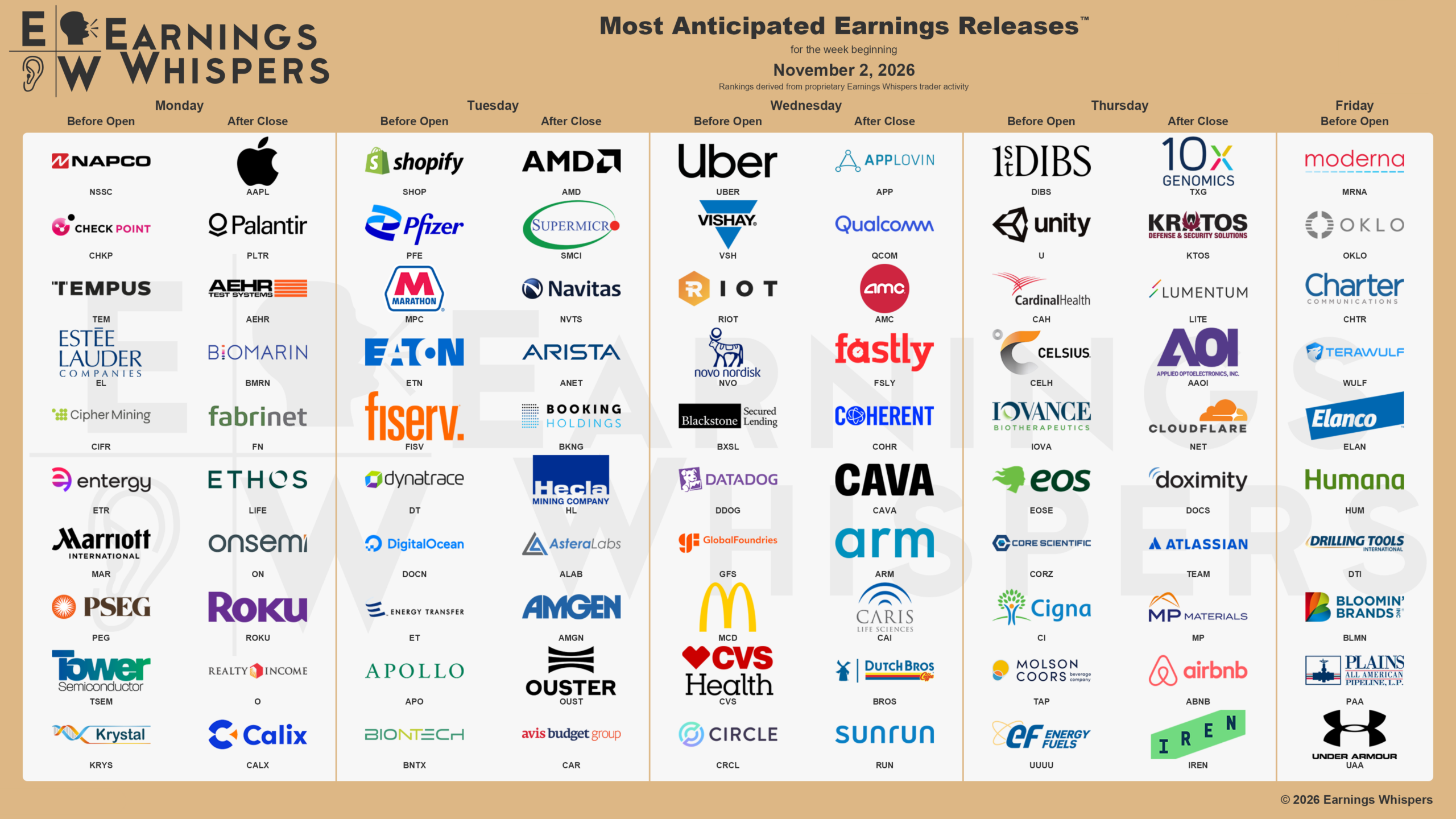
Marriott before the open; Apple, Palantir, and Vertex Pharmaceuticals after the close |
|
Tuesday, Nov. 3 |
|
|
All day |
Midterm Election Day |
|
10:00 AM |
JOLTS Job Openings (September) and Factory Orders |
|
Earnings |
Pfizer, Shopify, and Marathon Petroleum before the open; AMD, Amgen, Arista Networks, and Booking Holdings after the close |
|
Wednesday, Nov. 4 |
|
|
8:15 AM |
ADP National Employment Report (October) |
|
8:30 AM |
U.S. International Trade in Goods and Services |
|
10:00 AM |
ISM Services Index (October) |
|
Earnings |
Uber and CVS Health before the open; Qualcomm, Arm, DoorDash, and AppLovin after the close |
|
Thursday, Nov. 5 |
|
|
8:30 AM |
Productivity and Costs, Preliminary (Q3) |
|
8:30 AM |
Weekly Jobless Claims |
|
Earnings |
ConocoPhillips, Duke Energy, and Cigna before the open; Airbnb, Cloudflare, and Monster Beverage after the close |
|
Friday, Nov. 6 |
|
|
8:30 AM |
Employment Situation (October Jobs Report) |
|
Earnings |
Moderna, Humana, and Enbridge before the open |
Source: Bureau of Labor Statistics, Census Bureau, Institute for Supply Management, ADP, and Department of Labor release schedules; company earnings dates per the Nasdaq earnings calendar via StockTitan. Times are Eastern and subject to change.

About Amit: I am a first generation American, the son of a working-class Indian family, and I lived through my parents’ struggle to find their place in this country, to put down roots that would sustain them as well as their children in a new land. As they encouraged me to excel in school and fostered my hobbies and interests, I was keenly aware of the dynamic between them. I understood that there was a difference between where they came from individually and where we were now. They worked hard in their individual capacities, but they weren’t always on the same page about financial issues – and that can make or break a family’s future. I didn’t know it at the time, but this laid the groundwork for my passion towards financial services and helping families succeed.
IMPORTANT NOTICE AND DISCLOSURE
The information and material contained in this communication is confidential and intended for the recipient addressee named. If you are not the intended recipient please delete the message and notify the sender immediately.
NewEdge Advisors, LLC is an Investment Adviser registered with the Securities and Exchange Commission. Any information provided has been obtained from sources considered reliable, but we do not guarantee the accuracy or the completeness of any description of securities, markets or developmentsmentioned. As a precautionary measure, we cannot rely on e-mail requests to authorize, direct or effect the purchase or sale of any security, wire transfer, or to affect any other transactions. Such requests, orders, or other instructions sent by email should be confirmed verbally, prior to their anticipated execution. We are unable to ensure email sent to you from us, or sent from you to us will be received. Please contact us at 845-652-3449 if there is any change in your financial situation, needs, goals or objectives, or if you wish to initiate any restrictions on the management of the account or modify existing restrictions. Additionally, we recommend you compare any account reports from NewEdge Advisors LLC with the account statements from your Custodian. Please notify us if you do not receive statements from your Custodian on at least a quarterly basis. Our current disclosure brochure, Form ADV Part 2, is available for your review upon request. This disclosure brochure, or a summary of material changes made, is also provided to our clients on an annual basis. This material was prepared with the assistance of AI. All content has been reviewed, edited, and approved by Forefront Wealth Planning prior to use. This is general education and not a substitute for personalized tax, legal, or investment advice. Your situation should be reviewed with the appropriate professionals before taking action. Advisory services offered through NewEdge Advisors, LLC, a registered investment adviser.