

Rally, Pullback, or Both
The pros are split on what stocks do next. Here’s how to build a year end plan that works either way.
WEEKLY BLOG 10/25/26 – 10/31/26
The Federal Reserve announces its next interest rate decision this Wednesday, October 28. Election Day is six days after that. Going into both, the professionals I follow are split almost down the middle on what stocks do next.
One camp thinks the selling is mostly done and a year end rally is setting up. The other thinks there’s at least one more rough stretch first. Both make good arguments. I’d rather understand both than pretend I know which one wins.
The spark was Thursday, October 22. The Nasdaq fell 2.6% after Meta and Tesla reported earnings and revived worries about how much companies are pouring into AI. Last week I wrote about how the headline index can hide what most stocks are actually doing in The Market Had a Bad Week. A Lot of the Market Didn’t. This week is about what might come next. More importantly, it’s about what to do with it if you have a lot riding on the answer.
That last part matters. A 20% drop at 35 is something you’ll barely remember. At 58, with a date circled for when you stop working and a tax bill that already stings, the same drop is a real decision.
Same market. Very different stakes.
That’s who I’m writing to this week.
The case for a year end rally
The optimists start with the calendar. Historically, the S&P 500 has averaged a 6.6% gain in the fourth quarter of midterm years. Bank of America notes that since World War II, the index has been higher 12 months after every midterm election. Plenty of those years came with their own scary headlines. History doesn’t promise anything, but it does give this camp some cover.
Next is positioning. Goldman Sachs data shows hedge funds shorting roughly five times as much as they’re buying, with bearish bets near a five year high. That sounds ominous. It can cut the other way. When almost everyone is set up for bad news, it doesn’t take much good news to force them to buy back in. That’s a short squeeze, and they tend to move fast.
Last is the rest of the economy. Last week’s rally in everything outside big tech says money is rotating within the market, not leaving it. Investors are shuffling chairs, not heading for the exits.
The short version. When fear is widespread and bets are lopsided, markets have often surprised to the upside.
The case for a deeper pullback first
The cautious camp isn’t calling for a crash. They’re pointing at pressures that haven’t gone anywhere.
Inflation is moving the wrong way. Consumer prices rose 3.7% over the past year in September, up from 3.4% in August, driven largely by gasoline up 34%. Energy costs tied to the conflict with Iran are doing most of the damage, and energy rarely stays in its own lane. It shows up in shipping, groceries and eventually wages.
Rates are still high and the Fed is still leaning toward raising them. The Fed raised rates in September for the first time since 2023. The 10 year Treasury yield hit about 5.36% on October 7, its highest since 2002, before falling back just under 5% during last week’s selloff. That drop came from investors running to safety, not from the inflation problem going away. Higher rates make borrowing more expensive. They also make a safe bond look a lot more competitive with a risky stock.
Prices are already stretched. The Shiller CAPE ratio, a long term valuation measure, sits around 41. The long run average is near 17, and the peak in December 1999 was 44. Valuations tell you almost nothing about next month. They do tell you how little room there is for disappointment.
And crowded trades can unwind in either direction. On October 22, every major type of stock hedge fund lost more than 1% in a single day for the first time since the 2020 pandemic. When professionals are forced to cut risk quickly, they sell what they can, not what they should. That selling spills into places that had nothing to do with the original problem.
The short version. The economy may be fine. Expensive markets plus high rates has historically meant a bumpy ride.
The two camps, side by side
|
|
The rally camp |
The pullback camp |
|
The view |
The selling is mostly done and a year end rally is setting up |
At least one more rough stretch comes first |
|
History and valuation |
Midterm year fourth quarters have averaged a 6.6% gain |
Shiller CAPE near 41, against a long run average near 17 |
|
Positioning |
Bearish bets near a five year high can fuel a fast short squeeze |
Crowded trades can unwind fast and spill into unrelated stocks |
|
Economy and rates |
Money is rotating within the market, not leaving it |
Inflation at 3.7% and a Fed still leaning toward hikes |
|
Tax moves that fit |
Give appreciated shares; trim concentrated stock |
Harvest losses; consider a Roth conversion |
Sources: J.P. Morgan Asset Management, Goldman Sachs prime brokerage data via 24/7 Wall St., Multpl, and CNBC, as cited below.
Both can be right
This is the part that rarely makes the news. A pullback could come first and a rally could follow. Big rebounds tend to show up right on the heels of big drops. Over the 20 years through 2024, 7 of the market’s 10 best days came within two weeks of the 10 worst.
Guessing wrong is expensive. Someone who put $10,000 in the S&P 500 in 2005 and stayed put had about $71,750 by the end of 2024. Missing just the 10 best days cut that to about $32,871. Less than half, from sitting out ten days in twenty years.
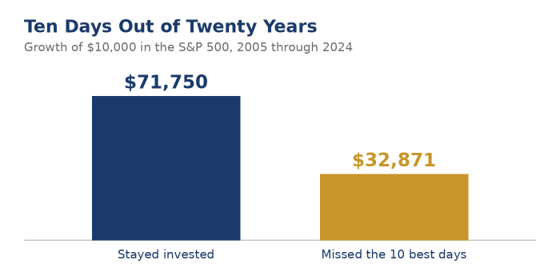
Source: J.P. Morgan Asset Management via CNBC, S&P 500 returns from 2005 through 2024. Past performance does not guarantee future results.
So I don’t spend much time picking a camp. I spend it making sure a plan works under either one.
Where taxes come in
For high earners, the market question and the tax question become the same question this time of year. We’re nine weeks from December 31. Whatever the market does between now and then, it changes what’s worth doing before the year closes.
If the cautious camp is right, a pullback creates tax opportunities that don’t exist in a calm market. Losses you harvest can offset gains elsewhere, plus up to $3,000 of ordinary income, with the rest carried forward. Watch the wash sale rule, which disallows the loss if you buy back the same position within 30 days. A dip can also be a good moment for a Roth conversion. You pay tax on the value you convert, so converting when prices are down moves more shares for the same tax bill. This matters most in the bridge years, the stretch between your last paycheck and when Social Security and required distributions start. Those are often the lowest tax years you’ll ever have.
If the rally camp is right, the questions change. Appreciated shares can be given to charity directly, or to a donor advised fund, instead of cash. You skip the capital gains and still get the deduction. If you hold concentrated company stock or have RSUs vesting, last week’s AI selloff is a reminder that one stock can move your whole picture. I wrote about how that concentration quietly piles up last week. Trimming it is a tax decision as much as an investment one.
Higher rates have a tax angle too. Cash finally pays something. For a New Jersey household in a top bracket, bank interest gets taxed at full federal and state rates. Treasury interest is exempt from New Jersey income tax. Municipal bonds can make more sense than they did a few years ago.
The yield on the screen is not the yield you keep.
None of these moves work well when you decide them in a hurry in mid December.
A few things worth checking this week
- Your borrowing and your cash. If the Fed keeps raising, cash earns more. A variable rate loan, a HELOC or a planned home purchase costs more.
- Money you’ll need soon. Tuition, a home project or the first few years of retirement should already be set aside. It shouldn’t depend on what the market does in November.
- Your sideline money. If the rally camp is right, make sure a scary October didn’t leave more in cash than you meant to.
- Your plan for a drop. If stocks fall 15 to 20 percent, you should already know what happens next. Rebalance, harvest losses, convert to Roth. Written down ahead of time, not figured out on the day it happens.
I’m curious where you land
I’d genuinely like to hear which camp you’re in. Strong finish to the year, or more turbulence first? I’m also curious whether last week’s headlines matched what you saw in your own accounts. Just hit reply. I read every response.
And if one of those checks gave you pause, that’s usually a sign the tax side and the investment side of your life aren’t talking to each other. That gap is where most of our work happens. A conversation tends to take less time than people expect, and it’s a lot more useful than the next headline.
Sources
The October 22 tech selloff. Fiona Riley, Forbes, “AI Stocks Slide As Spending Anxiety Festers After Tesla, Meta Earnings,” October 22, 2026. Nasdaq closing decline of 2.6% from Yahoo Finance, “Stock market today,” October 22, 2026.
Last week’s post. Amit Chopra, Forefront Wealth Planning, “The Market Had a Bad Week. A Lot of the Market Didn’t.,” October 19, 2026.
Midterm year fourth quarters. J.P. Morgan Asset Management, “How do markets perform in midterm election years?,” July 2026. Also covered by Fortune, “In midterm years, October is usually the best month for stocks,” September 23, 2026.
Returns after midterm elections. investingLive, “S&P 500 defies midterm slump as Bank of America says history favours post-election gains,” October 2026.
Hedge fund short positioning. 24/7 Wall St., “Hedge Funds Are Shorting Stocks at Near-Record Levels,” October 23, 2026. Based on Goldman Sachs prime brokerage data.
September inflation and the Fed’s September hike. CNBC, “Consumer prices rose 3.7% annually in September as gas prices skyrocket,” October 14, 2026. Also covered in CBS News video, “Breaking down September’s CPI report,” October 14, 2026.
The 10 year Treasury yield. NBC News, “AI boom and soaring debt push U.S. Treasury yields to highest levels since 2002,” October 7, 2026. The pullback below 5% from Top1 Markets, “The 10-Year Treasury Yield Just Had Its Biggest Drop Since 2023,” October 2026.
Shiller CAPE ratio. Multpl, “Shiller PE Ratio by Month,” data as of October 2026. Underlying data from Robert Shiller, Yale University.
Hedge fund losses on October 22. Hedgeweek, “Hedge funds suffer worst daily losses since Covid as tech rout deepens,” October 2026. Based on Goldman Sachs prime brokerage data.
Missing the market’s best days. CNBC, “Selling out during the market’s worst days can hurt you, research shows,” April 2025, as syndicated by NBC Miami. Data from J.P. Morgan Asset Management, covering 2005 through 2024.
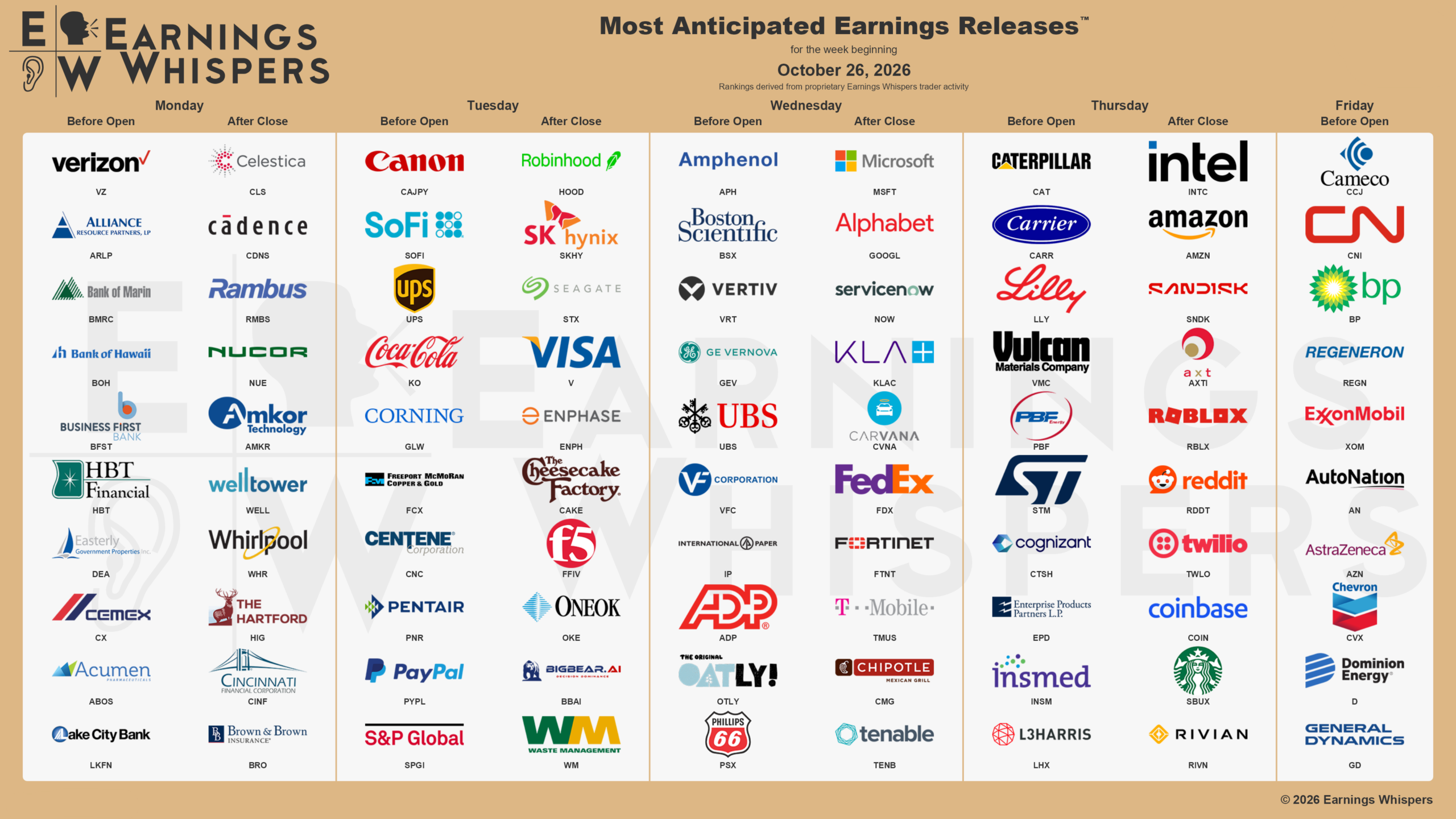
Stock Market Calendar This Week:
|
Time (ET) |
Report |
|
Monday, Oct. 26 |
|
|
10:30 AM |
Dallas Fed Manufacturing Index (October) |
|
Earnings |
Verizon before the open; Cadence Design Systems, Nucor, and Amkor Technology after the close |
|
Tuesday, Oct. 27 |
|
|
All day |
Two day Federal Reserve (FOMC) meeting begins |
|
8:30 AM |
Durable Goods Orders (September) |
|
10:00 AM |
New Home Sales (September) and Consumer Confidence (October) |
|
Earnings |
UPS and Boeing before the open; Visa after the close |
|
Wednesday, Oct. 28 |
|
|
2:00 PM |
FOMC Interest Rate Decision and Policy Statement |
|
2:30 PM |
Fed Chair Press Conference |
|
Earnings |
Alphabet and Microsoft after the close |
|
Thursday, Oct. 29 |
|
|
8:30 AM |
Gross Domestic Product, Advance Estimate (Q3) |
|
8:30 AM |
Personal Income and Outlays, including PCE Inflation (September) |
|
8:30 AM |
Weekly Jobless Claims |
|
Earnings |
Mastercard, Eli Lilly, and Caterpillar before the open; Amazon and Intel after the close |
|
Friday, Oct. 30 |
|
|
8:30 AM |
Employment Cost Index (Q3) |
|
9:45 AM |
Chicago Purchasing Managers’ Index (October) |
|
Earnings |
ExxonMobil and Chevron |
Source: Federal Reserve, Bureau of Economic Analysis, Census Bureau, Conference Board, Department of Labor, and regional release schedules; company earnings dates per TradingKey. Times are Eastern and subject to change.

About Amit: I am a first generation American, the son of a working-class Indian family, and I lived through my parents’ struggle to find their place in this country, to put down roots that would sustain them as well as their children in a new land. As they encouraged me to excel in school and fostered my hobbies and interests, I was keenly aware of the dynamic between them. I understood that there was a difference between where they came from individually and where we were now. They worked hard in their individual capacities, but they weren’t always on the same page about financial issues – and that can make or break a family’s future. I didn’t know it at the time, but this laid the groundwork for my passion towards financial services and helping families succeed.
IMPORTANT NOTICE AND DISCLOSURE
The information and material contained in this communication is confidential and intended for the recipient addressee named. If you are not the intended recipient please delete the message and notify the sender immediately.
NewEdge Advisors, LLC is an Investment Adviser registered with the Securities and Exchange Commission. Any information provided has been obtained from sources considered reliable, but we do not guarantee the accuracy or the completeness of any description of securities, markets or developmentsmentioned. As a precautionary measure, we cannot rely on e-mail requests to authorize, direct or effect the purchase or sale of any security, wire transfer, or to affect any other transactions. Such requests, orders, or other instructions sent by email should be confirmed verbally, prior to their anticipated execution. We are unable to ensure email sent to you from us, or sent from you to us will be received. Please contact us at 845-652-3449 if there is any change in your financial situation, needs, goals or objectives, or if you wish to initiate any restrictions on the management of the account or modify existing restrictions. Additionally, we recommend you compare any account reports from NewEdge Advisors LLC with the account statements from your Custodian. Please notify us if you do not receive statements from your Custodian on at least a quarterly basis. Our current disclosure brochure, Form ADV Part 2, is available for your review upon request. This disclosure brochure, or a summary of material changes made, is also provided to our clients on an annual basis. This material was prepared with the assistance of AI. All content has been reviewed, edited, and approved by Forefront Wealth Planning prior to use. This is general education and not a substitute for personalized tax, legal, or investment advice. Your situation should be reviewed with the appropriate professionals before taking action. Advisory services offered through NewEdge Advisors, LLC, a registered investment adviser.