

Predictions, Meet Reality
Yogi Berra had it right. Predictions are hard. They get even harder when headlines are moving markets by the hour.
We just wrapped up our 2Q26 outlook. The timing wasn’t ideal. Markets were reacting in real time to news around a possible ceasefire in Iran. That kind of backdrop doesn’t make forecasting easier. It just reminds you how little control we actually have over the inputs.
Here It Goes Again
We titled the outlook “Here it Goes Again.” Part nostalgia, part reality check. This is now the fourth major supply shock in six years. At some point, you stop calling these events “unprecedented” and start treating them as part of the cycle.
Markets have handled it better than most expected. The S&P 500 has returned about 13 percent annually since 2020. That’s above its long-term average. Even now, we’re sitting just a few percent off all-time highs despite real disruption in global energy markets.
That kind of resilience can make it easy to dismiss what’s happening beneath the surface. That would be a mistake.
What’s Actually Changing
There have been clear winners and losers. The 40-year bull market in bonds is over. Commodities, on the other hand, have quietly entered a bull phase. That shift matters. It tells you the environment is changing, even if headline equity returns haven’t fully reflected it yet.
A big part of equity resilience has come from liquidity and a narrow set of drivers. Policy has stayed supportive. Technology and AI have carried more weight than usual. That combination has allowed earnings and valuations to hold up better than the macro backdrop would suggest.
The Bigger Shift
We’ve been thinking about this through a framework we call “The Revenge of the Real World.” We’re in the third major rotation cycle of the past 50 years. These periods tend to be driven by supply shocks, fiscal policy dominance, and the unwinding of concentration in markets. It’s early, but the pieces are lining up.
What Matters Right Now
The war matters, but not in an abstract way. It shows up in oil flows and infrastructure risk. Are tankers moving through the Strait of Hormuz? Is production capacity offline? Those are the variables that drive real economic impact.
Higher energy costs feed through quickly. Consumers pay more at the pump. Businesses pay more to move goods. That eventually shows up in prices. Food, transportation, and anything tied to logistics start to feel it.
The U.S. Economy
Before the conflict escalated, the U.S. economy was holding up. Business investment was improving. Orders for capital goods were trending higher. The weak spots were the consumer and the labor market, where the data has been inconsistent at best.
The labor market is likely to stay in a low hire, low fire pattern. You don’t need strong job growth to keep unemployment stable if the labor force is shrinking. Wage growth should continue to cool.
Inflation is a different story. Headline inflation will move higher, driven by energy. Core inflation is still sticky. That puts the Fed in a difficult spot.
The Fed’s Position
Right now, the Fed’s job is simple. Don’t make it worse.
Cutting rates into a supply-driven inflation spike doesn’t fix the labor market. It risks unanchoring inflation expectations. That’s a bigger problem. So the most likely path is patience. Hold rates steady and wait for either inflation to peak or the labor market to weaken enough to justify action.
Fixed Income
Fixed income has already adjusted. Rates moved higher earlier this year on the expectation that inflation would stay elevated. That reset has created some opportunity, especially in areas like municipal bonds, where the risk-adjusted return looks more attractive.
Equities
Equities are dealing with a different tension. Earnings expectations for 2026 and 2027 are still high. That leaves less room for upside surprises. At the same time, institutional investors are underweight equities. That creates the setup for sharp moves higher if the news flow improves.
For long-term investors, the message hasn’t changed much. Stay invested, but be more disciplined. This isn’t the same environment as the last few years.
It’s less about swinging for the fences and more about managing the course. Focus on quality. Own businesses with durable earnings. Use volatility rather than react to it. Rebalance when positions get extended.
Under the surface, there are still positives. Earnings growth is broadening. Revisions have been improving. Momentum is holding up. Those are supportive factors.
But expectations are high. Valuations are full. The margin for error is thinner. That shifts the risk-reward balance.
What to Expect
The base case is still positive returns, just more modest. More dispersion. More reliance on fundamentals instead of multiple expansion.
None of this is unusual. Periods of geopolitical stress and policy uncertainty have historically been good entry points for patient investors. Not because the environment feels good, but because expectations are reset.
Final Thought
This year has been a reminder that “unprecedented” events tend to repeat. Volatility is not an exception. It’s part of the process.
The approach doesn’t need to change. Stay disciplined. Do the work. Tune out the noise. Use the volatility when it shows up.
That’s where the opportunity is.
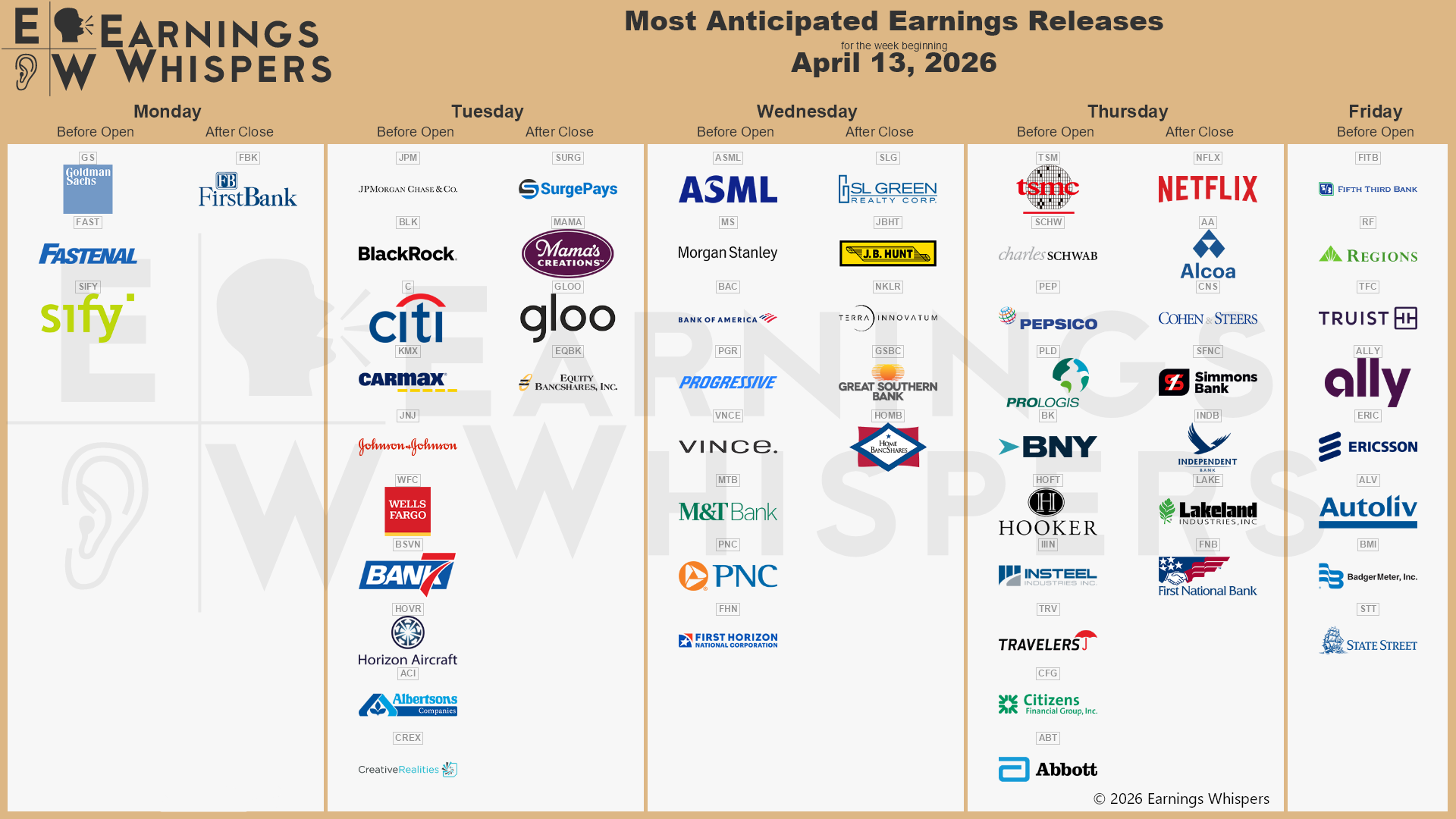
| Time (ET) | Report |
| MONDAY, APRIL 13 | |
| 10:00 AM | Existing home sales |
| 6:20 PM | Fed governor Stephen Miran speaks |
| TUESDAY, APRIL 14 | |
| 6:00 AM | NFIB optimism index |
| 8:30 AM | Producer price index |
| 8:30 AM | Core PPI |
| 8:30 AM | PPI year over year |
| 8:30 AM | Core PPI year over year |
| 5:50 PM | Fed governor Michael Barr speaks |
| 1:00 PM | Boston Fed President Susan Collins, Richmond Fed President Tom Barkin and Philadelphia Fed President Anna Paulson on a panel about rural economy |
| WEDNESDAY, APRIL 15 | |
| 8:30 AM | Import price index |
| 8:30 AM | Import price index minus fuel |
| 8:30 AM | Empire State manufacturing survey |
| 8:30 AM | Fed governor Michael Barr speaks |
| 10:00 AM | Home builder confidence index |
| 1:45 PM |
Fed Vice Chair for Supervision Michelle Bowman
speaks
|
| 2:00 PM | Fed Beige Book |
| THURSDAY, APRIL 16 | |
| 8:30 AM | Initial jobless claims |
| 8:30 AM | Philadelphia Fed manufacturing survey |
| 8:35 PM | New York Fed President John Williams speaks |
| 9:15 AM | Industrial production |
| 9:15 AM | Capacity utilization |
| 10:35 AM | Fed governor Stephen Miran speaks |
| FRIDAY, APRIL 17 | |
| 11:30 AM | San Francisco Fed President Mary Daly speaks |
| 12:15 PM | Richmond Fed president Tom Barkin speaks |
| 2:00 PM | Fed governor Christopher Waller speaks |

About Amit: I am a first generation American, the son of a working-class Indian family, and I lived through my parents’ struggle to find their place in this country, to put down roots that would sustain them as well as their children in a new land. As they encouraged me to excel in school and fostered my hobbies and interests, I was keenly aware of the dynamic between them. I understood that there was a difference between where they came from individually and where we were now. They worked hard in their individual capacities, but they weren’t always on the same page about financial issues – and that can make or break a family’s future. I didn’t know it at the time, but this laid the groundwork for my passion towards financial services and helping families succeed.