

My Vacation to The Dominican Republic Made Me Think About Luck
I’m writing this from the Dominican Republic.
I’m here with Christina and the kids. My brother, his wife, and their three kids. My parents, too. The whole crew. We’re eating good food, watching the kids run around like maniacs, and spending time together you don’t get enough of in everyday life.
It’s beautiful here. The weather is perfect. The ocean looks fake. And the kids are at that sweet spot in age where they’re still excited by everything.
It’s one of those trips where you look around and think, man, we’re lucky.
And I mean lucky in the truest sense.
While we’re sitting by the pool or walking through the villa, we’re surrounded by people working. Staff clean rooms, and servers run food and Pina Coladas to the kids nonstop. Workers out in the heat, smiling, helping, moving, hustling.
It’s impossible to ignore the gap.
We didn’t earn the right to be guests rather than staff.
We were born into it.
That’s the part easy to forget when you live your whole life in the U.S. The default setting is comfort. The baseline expectation is that if you work hard enough, you’ll figure it out.
But being here makes the truth harder to ignore.
Hard work matters, but luck matters too. A lot.
And one of life’s most significant pieces of luck is where you were born.
The Luck That Doesn’t Show Up on a Resume
There’s a popular idea floating around that people end up where they are because of choices. And sure, choices matter.
But choice exists only when you have options.
A kid born in New Jersey grows up surrounded by basic assumptions. Schools, roads, clean water, and access to a system that creates opportunity. It’s not perfect. Not even close. But the floor is higher.
In much of the world, the floor is lower. Way lower. And the margin for error is thin.
When you grow up in a place where one illness can wipe out a family, where jobs are scarce, or where you’re working for cash and hoping today is a good day, the whole game is different.
It doesn’t mean people aren’t working hard.
It means they’re working hard in a completely different environment.
When we talk about financial success as if it’s purely a merit badge, we ignore the biggest truth.
The deck isn’t evenly shuffled.
The Numbers That Should Make Everyone Pause
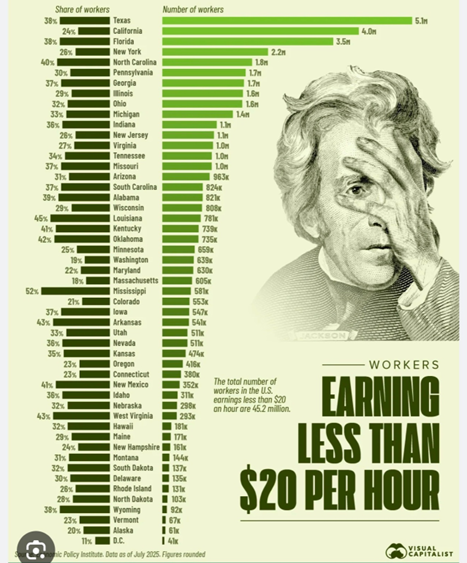
Look at the graphic above showing the number of U.S. workers earning less than $20 an hour.
The total is 45.2 million.
That’s not a small group. That’s a massive share of the country working full-time and still not earning enough to feel secure.
Texas has over 5 million workers earning under $20 an hour. California has 4 million. Florida has 3.5 million. New York has 2.2 million.
And in some states, more than 40 percent of workers earn less than $20 an hour. In Mississippi, it is over 50 percent.
That means even in the U.S., where people assume everyone has a shot, millions are working hard and still stuck in survival mode.
And that’s where this ties back to being here.
Because the resort staff we see every day are working just as hard as anyone in our group ever has, probably harder, and for less.
And even when you bring it back to the U.S., tens of millions of workers are doing the same thing. Working hard. Showing up. Grinding. Still not getting ahead.
Hard Work Is Required. But Hard Work Isn’t Always Enough
This isn’t an argument against personal responsibility.
I’m obsessed with personal responsibility. That’s how I’m wired. It’s what I do for a living.
But personal responsibility is only part of the equation.
Two people can work equally hard and still get very different outcomes because of timing, geography, family support, health, opportunity, and plain old luck.
I’ve seen it in my own life. I’ve seen people derailed by forces beyond their control. I’ve seen others catch breaks that changed everything.
If you’re honest, you’ve seen it too.
So, the idea that people are either winners or lazy is nonsense.
It’s comforting to believe because it makes the world feel fairer.
But it’s not.
Gratitude Isn’t a Feeling. It’s a Skill
This trip has been incredible. The kids are having the time of their lives. Christina is happy. My parents and my brother are here. That’s not something I take lightly.
As we approach the end of 2025 and head into 2026, this is what I want to carry with me.
Gratitude isn’t just a feeling you have when things are going well. Gratitude is a skill.
It’s the ability to look at your life and recognize how much of it rests on things you didn’t control. Your health. Your family. Your education. You’re timing. Your passport. Your ability to even take a trip like this.
You can work hard and still be grateful. Those two things aren’t at odds. In fact, they should go together.
Because gratitude keeps success from becoming arrogant and comfort from becoming entitlement.
And I’ll be honest; this trip also makes me think about the people who make my life back home possible.
I’m grateful for my clients. Not in a cheesy thank you for the business way. I mean, the real kind of thankful. The kind where you realize someone trusted you with their family’s future. They let you into their lives. They share their worries, goals, mistakes, and wins. That trust is not something I take lightly.
I’m grateful to my staff, too. They help keep everything moving while I’m away. They handle the details, solve problems, and care for clients when I’m unavailable. I get to be present with my family on this trip because I have a team that shows up and takes pride in their work.
Many people don’t realize that. Many people can’t leave work behind, even for a weekend.
So, when I say I feel lucky, I’m talking about all of it. My family, my health, my opportunities, and the chance to do work that matters with people I genuinely respect.
What This Means for Your Money in 2026
If you’ve got financial stability, don’t squander it.
Save like you’re protecting something rare, because you are.
Build a margin so one bad month doesn’t turn into a crisis. Pay down debt so your paycheck belongs to you again. Keep your lifestyle in check so you don’t become a prisoner of your spending. Be generous when you can. And be slower to judge people stuck in situations you’ve never had to live through.
Because no matter how hard you work, life can change quickly. And no matter how smart you are, the world still plays a role.
Closing 2025
One day, the kids will be grown. My parents won’t be traveling with us. My brother will be busy with his own life, and so will I. This exact moment, this same version of our family, this exact trip, is not guaranteed to happen again.
That’s what luck really is. It’s not winning the lottery. It’s getting a life that gives you a chance to build something. It’s having your people healthy enough to be with you. It’s having work that lets you step away for a week without everything falling apart. It’s being born in a country where your effort can create options, even if it’s not perfect.
As we head into 2026, I’m taking this with me.
Work hard. Take responsibility. Keep building.
But hold it with humility.
Because none of us are entirely self-made, we are all a blend of effort and opportunity, discipline and timing, preparation and luck.
If you’ve caught some breaks, don’t waste them. Use them well. Take care of your family and your future. And if you’re able to help someone else climb, do it.
That’s what gratitude looks like in real life.
Stock Market Calendar This Week:
| Time (ET) | Report |
| MONDAY, DEC. 29 | |
| 10:00 AM | Pending home sales |
| TUESDAY, DEC. 30 | |
| 9:00 AM | S&P Case-Shiller home price index (20 cities) |
| 9:45 AM | Chicago Business Barometer (PMI) |
| 2:00 PM | Minutes of Fed’s December FOMC meeting |
| WEDNESDAY, DEC. 31 | |
| 8:30 AM | Initial jobless claims |
| THURSDAY, Jan. 1 | |
| New Year’s Day holiday | |
| FRIDAY, JAN. 2 | |
| 9:45 AM | S&P final U.S. manufacturing |
Did you miss our last blog?
About Amit: I am a first generation American, the son of a working-class Indian family, and I lived through my parents’ struggle to find their place in this country, to put down roots that would sustain them as well as their children in a new land. As they encouraged me to excel in school and fostered my hobbies and interests, I was keenly aware of the dynamic between them. I understood that there was a difference between where they came from individually and where we were now. They worked hard in their individual capacities, but they weren’t always on the same page about financial issues – and that can make or break a family’s future. I didn’t know it at the time, but this laid the groundwork for my passion towards financial services and helping families succeed.